Update on the Pin Badges and Messages from Our Members

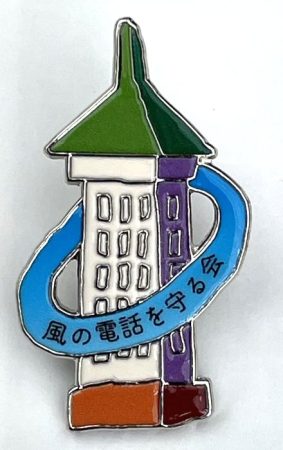
We have now completed the shipment of pin badges to our members in Japan, and we will continue to send them to new members as they join.

Regarding our members overseas, we initially placed the pin badges in envelopes, addressed them, and took them to the post office, where they were accepted. However, they were later returned to us because we were informed that postal regulations had changed and that they could no longer be sent in this manner.

We were also told that, for international mail, a written message and an item must be sent separately, and that sending them together would cost approximately 3,500 yen per package. We are therefore considering sending our messages by email and mailing the pin badges separately as small parcels.

We sincerely apologize to our overseas members for the delay and kindly ask for a little more time while we work out the best way to send the badges to you.

Meanwhile, we have received many heartfelt messages from members in Japan who have already received their pin badges.

“Thank you very much for the beautiful pin badge. I will wear it proudly as a member of the Society for the Preservation of the Wind Phone, and I hope that people who share this spirit will spread throughout the world.”

“When I wear the badge on my chest, I feel a sense of comfort, as though I am surrounded by a gentle breeze of kindness. I hope this circle of compassion will spread across the world.”

We have also received comments such as:

“The world continues to be troubled by war and conflict. In such a world, I feel great hope in the fact that a group like this has been created around the shared desire to ‘be of help to someone.’”

These warm and encouraging messages give us great strength and inspire us to continue our work.
A Shared Commitment, Expressed in a Pin Badge

Three months have passed since the establishment of the Association to Protect Wind Phone. During this time, we have received support from people in Japan and around the world, for which we are deeply grateful.

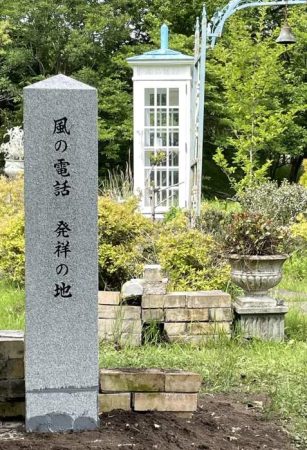
Our activities include welcoming and assisting daily visitors, mowing the grass and maintaining the surrounding environment, and making improvements such as erecting a monument marking the Birthplace of Wind Phone. Step by step, we are establishing the role and purpose of Wind Phone as a place of global significance.

Amid these developments, we wanted to give form to the commitment shared by our members: “to be of help to others.” Since around April, we have worked with a manufacturer on several designs for a pin badge. The final design was approved in July, and production began shortly thereafter.

The finished pin badges have now arrived, and we will begin sending them to members of the Association to Protect Wind Phone.

The idea that inspired the creation of Wind Phone began with kindness toward others. Kindness means standing beside someone, sharing what they carry, and supporting one another.

The advancement of artificial intelligence in recent years has been remarkable. AI has access to an amount of information and knowledge far beyond that of any individual and can respond to our questions almost instantly. Put simply, we are entering an age in which our role may increasingly be to decide whether the answers provided by AI are appropriate for the circumstances at hand.

In such an age, what truly matters to us as human beings?

Perhaps it is to nurture our sensibilities, develop our imagination, and cultivate the capacity for empathy. We believe these qualities are what lead to kindness.

By wearing the pin badge of the Association to Protect Wind Phone, we hope each member will take pride in being part of a worldwide community and in living true to their own inner values. We also hope that this circle of kindness and quiet pride will continue to grow.

For more information about the Association to Protect Wind Phone, please visit our website and blog.

We sincerely appreciate your support and warmly invite you to become a member of this compassionate community.

Japan’s First Officially Recognized “Wind Phone” Established in Kitakata, Fukushima Prefecture

On June 16 of this year, Japan’s first officially recognized “Wind Phone” was completed. Sadly, its founder, Mr. H, passed away from pancreatic cancer on July 10. We understand that those who helped build the Wind Phone, together with Mr. H’s elder sister, are now carrying out the exterior landscaping and garden work and will continue to maintain the site.

Having lost his wife before him, Mr. H longed to convey his thoughts and feelings to her while he himself was battling pancreatic cancer. This inspired him to establish a Wind Phone. With the help of his friends, he managed to complete it on June 16. By then, he was using a wheelchair, but we have been told that he was the very first person to use the phone.

In Japan, “Wind Phone” is a registered trademark in Classes 9, 16, and 41. Therefore, a licensing fee is required for any use of the name or concept. In the past, several people have expressed an interest in creating a Wind Phone, but most of those plans were abandoned because of the licensing fee. Mr. H’s case was exceptional, as he devoted himself to the project while risking his life to see it completed.

P.S. The monument inscribed “Birthplace of the Wind Phone,” featured in our previous post, was erected on June 13 by the Association for the Preservation of the Wind Phone. We sincerely thank all members of the Association for their support and cooperation.

Plan to Establish a Monument Marking the Birthplace of the Wind Phone

The Wind Phone, located on a hill in Namiita, Otsuchi Town, was established in December 2010. It was originally created out of personal grief following the death of my cousin.

The following year, the Great East Japan Earthquake claimed many precious lives, leaving behind bereaved family members many times greater in number, each carrying grief and enduring deep sorrow. Seeing the situation before my eyes, I felt that, as one of those who had survived, there was something I could do. I planted trees and flowers in the area where the Wind Phone had been installed, placed potted plants there, and laid stone slabs along the path, opening the space as an earthquake memorial garden that anyone could use at any time, free of charge.

Over time, it came to be regarded as a symbolic presence for people facing the grief of bereaved families and many others. The historical background of the Great East Japan Earthquake—the collective sorrow of that time and the need for healing—had a strong influence. The Wind Phone can therefore be said to have evolved from a personal memorial device into a social symbol of grief care born in the wake of the disaster.

Today, people visit not only from within Japan but also from many countries around the world, seeking the original Wind Phone. At present, more than 600 Wind Phones have been installed worldwide. Considering the current global situation, it is likely that uncertainty will continue for some time. In addition, the sorrow of losing a loved one is a deeply human emotion that remains unchanged in every era and in every country. For these reasons, I believe the number of Wind Phones will continue to increase.

As the Association for Preserving the Wind Phone, we have decided to establish a monument marking “the Birthplace of the Wind Phone.” Through this, we hope to seek everyone’s support in maintaining and preserving the environment as it is, while also clearly recording and examining the history of the Wind Phone, both past and future.

For more information about the Association for Preserving the Wind Phone, please visit our website.

What Do We Feel Happiness To Be?

In his “Outline of the Theory of Peasant Art,” Kenji Miyazawa wrote, “Until the whole world becomes happy, there can be no individual happiness.” As an ideal, I have no objection to this thought. But is it perhaps an abstract image of an ideal?

After all, what people feel to be happiness differs from one individual to another. How, then, should we understand the sense of happiness of the world as a whole?

In my own case, to give a familiar example, there was a plant called “Sanji-so” in a flowerpot. It had grown so densely that even when I watered it, the water would not soak into the soil. Only four or five flowers would bloom. This year, I replanted it in a slightly larger pot, and as many as twenty flowers bloomed beautifully. I could tell that the plant was happy. Seeing that made me feel happy.

Also, when people who have come from unfamiliar countries visit the “Phone of the Wind” and say things such as, “What a beautiful place this is,” or “This is a necessary place for people whose hearts have nowhere to go. Please continue to preserve it for many years to come,” I am filled with deep happiness, along with a sense of profound emotion.

Perhaps it is because of my age, but I can no longer find many things that I truly want. The happiness I feel when I see the relieved expressions of people who visit the “Phone of the Wind,” whose hearts have been “healed” or “saved,” is something that cannot be replaced by anything else.

When people speak about their own happiness, I believe it reveals what they have thought about, what they have done, and how they have lived.

A human life lasts around eighty years, which is a long span of time, while the life of flowers and plants is short, lasting only about a year. For that very reason, the results of the actions and care of the person who raises them appear immediately in the plants. In the case of human beings, however, the results of a person’s actions do not appear right away. They gradually emerge as consequences. Even if a person becomes angry and asks, “Why must I go through something like this?” they must recognize that everything is the result of their own actions.

Therefore, it is only natural that what kind of state can be called happiness differs from person to person. I believe it is impossible to gather the happiness of the entire world into one single understanding.

What do you feel happiness to be?